Breiman, L. (2001). Random forests. Machine Learning, 45(1), 5-32. https://doi.org/10.1023/A:1010933404324
Dastourani, M., Mamirabadizadeh, M., & Mohammadie, K. (2025). The Impact Assessment of Changes in Agricultural Cropping Patterns on the Quantitative Status of Groundwater Resources in the Qaen Plain Aquifer Using the MODFLOW Model. Iranian Journal of Irrigation & Drainage, 19(4), 537-554. [In Persian]
Farzaneh, M. and Banimostafaarab, F. (2025). Qanat and climate resilience Investigating the climate legislations in developing countries from disaster risk management perspective. Journal of Aquifer and Qanat, 6(1), 67-86. https://doi.org/10.22077/jaaq.2025.8869.1097. [In Persian]
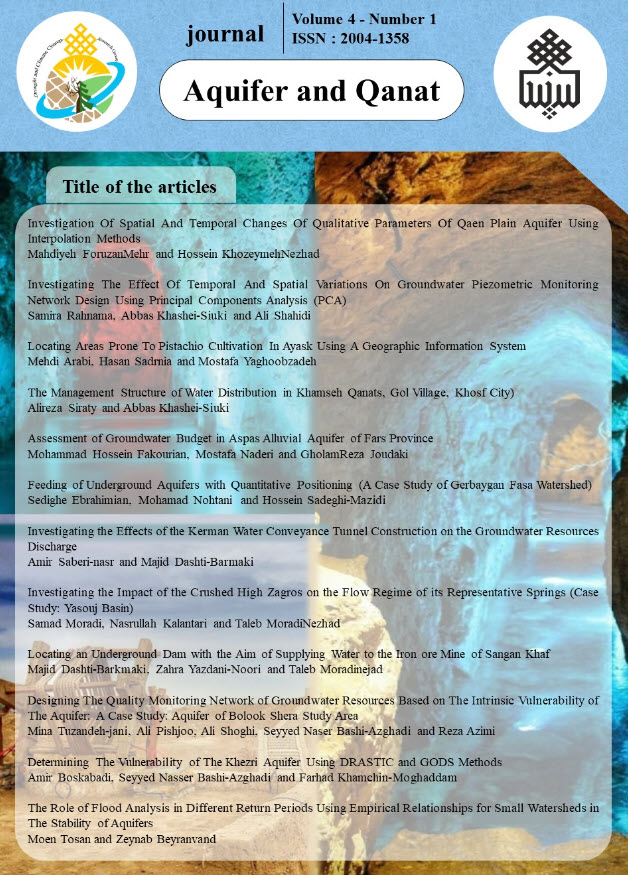
Foruzanmehr, M. and Khozeymehnezhad, H. (2023). Investigation of spatial and temporal changes of qualitative parameters of Qaen plain aquifer using interpolation methods. Journal of Aquifer and Qanat, 4(1), 1-15. https://doi.org/10.22077/jaaq.2023.5130.1045. [In Persian]
Hejazi, A., & Marzbani, M. (2015). Estimation of maximum runoff height and discharge using curve number method case study: Sarab Darehshahr Watershed. Hydro Geomorphol, 2(5), 63-81.
Kratzert, F., Klotz, D., Shalev, G., Klambauer, G., Hochreiter, S., & Nearing, G. (2019). Towards learning universal, regional, and local hydrological behaviors via machine learning applied to large-sample datasets. Hydrology and Earth System Sciences, 23(12), 5089-5110. https://doi.org/10.5194/hess-23-5089-2019
Maghrebi, M., Noori, R., Sadegh, M., Sarvarzadeh, F., Akbarzadeh, A. E., Karandish, F.,... & Taherpour, H. (2023). Anthropogenic decline of ancient, sustainable water systems: qanats. Groundwater, 61(1), 139-146. https://doi.org/10.1111/gwat.13248
Norouzi Qoshblagh, H., & Naderi, A. (2018). Prediction of groundwater level in the Bukan plain using fuzzy logic, random forest, and neural network models. Journal of Range and Watershed Management, 71(3), 829-845. https://doi.org/10.22059/jrwm.2018.68924. [In Persian]
Prieto, C., Le Vine, N., Kavetski, D., García, E., & Medina, R. (2019). Flow prediction in ungauged catchments using probabilistic random forests regionalization and new statistical adequacy tests. Water Resources Research, 55(5), 4364-4392. https://doi.org/10.1029/2018WR023254
Ramezani Feriz, A. H. and Ramezani, Y. (2025). Evaluation of the accuracy of artificial intelligence models in predicting qanat discharge in arid and semi-arid regions (Case study: Qaen Plain). Journal of Aquifer and Qanat, (), . https://doi.org/ 10.22077/jaaq.2025.10072.1124. [In Persian]
Rezaeian-Zadeh, M., Tabari, H., & Abghari, H. (2013). Prediction of monthly discharge volume by different artificial neural network algorithms in semi-arid regions. Arabian Journal of Geosciences, 6(7), 2529-2537. https://doi.org/10.1007/s12517-011-0517-y
Samani, S., Vadiati, M., Kisi, O., Ghasemi, L., & Farajzadeh, R. (2024). Qanat discharge prediction using a comparative analysis of machine learning methods. Earth Science Informatics, 17(5), 4597-4618. https://doi.org/10.1007/s12145-024-01409-0
Sedghi, M. M., & Zhan, H. (2024). Discharge variations of the qanat near an ephemeral stream. Journal of Hydrology, 637, 131367. https://doi.org/10.1016/j.jhydrol.2024.131367
Tang, T., Liang, Z., Hu, Y., Li, B., & Wang, J. (2020). Research on flood forecasting based on flood hydrograph generalization and random forest in the Qiushui River basin, China. Journal of Hydroinformatics, 22(6), 1588-1602. https://doi.org/10.2166/hydro.2020.147
UNESCO World Heritage Centre. (2016). Persian Qanat. Retrieved from https://whc.unesco.org/en/list/1506